
- Loan or overdrawn balance: a deemed benefit of 9% a year on the balance.
- Private use of company assets: a disguised dividend with 10% SDC for a domiciled owner.
- The two clean routes: payroll salary, or a declared dividend with SDC of 5% on profits from 2026 onwards (0% if non-domiciled) and GeSY of 2.65% up to a ceiling, to check with your accountant.
1. Three ways money leaves the company
The company is a separate person from you. Money that moves from its account to yours needs a legal description.
There are three possibilities.
| Route | What it looks like | Cost |
|---|---|---|
| Salary through payroll | A gross salary paid every month, with contributions and income tax handled through payroll. | Employer contributions, employee social insurance and GeSY, and PAYE. |
| A declared dividend | A dividend the company declares and pays from profit it has already paid corporate tax on. | SDC of 5% on profits from 2026 onwards (0% if non-domiciled) and GeSY of 2.65% up to a ceiling, withheld by the company. Check the current figures with your accountant. |
| Everything else | A loan or overdrawn balance with the company, or private use of company assets. | Sections 2 and 3 show the cost. |
The third route also covers buying an asset from the company for less than it is worth.
This guide does not argue for or against any route. It shows what the third one costs, so that you can compare it with the other two.
The first two routes are covered in the hub guide on Cyprus company owner pay, with an estimator.
2. A loan or overdrawn balance: the 9% deemed benefit
A loan from the company to you is a balance you owe the company. An overdrawn balance is the same thing.
The rule is simple. The balance carries a deemed benefit of 9% a year.
Here is an illustration. It is arithmetic on the 9% rate, not a figure from the reform publication.
| Balance you owe the company | Time outstanding | Rate | Deemed benefit |
|---|---|---|---|
| €20,000 | One year | 9% | €1,800 (€20,000 × 9%) |
Ask your accountant how the benefit is taxed in your case.
A balance can grow without any single decision. A series of small transfers adds up.
3. Private use of company assets
A company can own a car, a flat, equipment or other assets. If you use one of them privately, the company is giving you something of value.
The same applies when you buy an asset from the company below its market value.
In both cases the result is a disguised dividend. A disguised dividend carries SDC of 10% for a domiciled owner.
Compare that with a declared dividend, where SDC is 5% for a domiciled owner on profits from 2026 onwards and 0% for a non-domiciled owner.
Your accountant values the private use or the discount. Ask for that value before the year ends.
The 10% rate is the one for domiciled owners. If you are non-domiciled, ask your accountant what applies. The domiciled vs non-dom guide explains the two statuses.
4. Why "I'll sort it out at year end" costs money
A common plan is to take money during the year and clear the balance when the year closes. The plan has two costs.
The first cost is the benefit. It builds up for every month the balance is open, not only on the last day of the year.
The second cost is the way out. To clear a balance, the company has to pay you something that is a salary or a dividend.
- A salary carries the payroll cost: employer contributions, employee contributions and PAYE.
- A dividend carries SDC of 5% (0% if non-domiciled) and GeSY of 2.65%.
That cost is the one you would have paid by taking the money as salary or as a dividend in the first place.
There is a paperwork cost as well. Your accountant needs a record of every transfer to decide how to treat the balance. For each one, note the following.
- The date and the amount.
- The reason for the transfer.
- The balance you owe the company after it.
- Any repayment, with its date.
5. The two clean routes
The clean routes have a cost you can estimate before the money leaves. They are payroll salary and a declared dividend.
| Route | What the company does | What you pay | When the money arrives |
|---|---|---|---|
| Payroll salary | Pays employer contributions on top of the gross salary. The salary comes off profit before corporate tax. | Employee social insurance, GeSY and PAYE, taken through payroll. | Every month. |
| Declared dividend | Pays 15% corporate tax on profit first. It then declares a dividend from the after-tax profit. | SDC of 5% (0% if non-domiciled) and GeSY of 2.65%, withheld by the company and paid by the end of the following month. | When the company declares and pays it. |
The hub explains each route in detail. See salary through payroll and dividends.
The two routes can be combined. A small monthly salary with a dividend when profit allows is one common pattern. The hub estimator shows the result for your numbers.
Which route suits you depends on your domicile and your exemptions. The domiciled vs non-dom guide shows the same company with two different owners.
6. What the SoloTreasury sheet does here
SoloTreasury Cyprus Company Edition is a Google Sheet for the owner-director of one Cyprus company.
It does not calculate loans or benefits.
It shows an alert instead. The alert states that the safe-to-withdraw figure is valid only if money leaves the company as payroll salary or as a declared dividend.
If you have a loan or an overdrawn balance, keep it as a separate line in your own records. Ask your accountant for the amount of the benefit.
To see what is left each month after the reserves, read the monthly reserve guide. For the sheet itself, see the Cyprus Company Edition page.
See your planned salary and dividends next to the taxes the company owes
SoloTreasury Cyprus Company Edition is a Google Sheet for the owner-director of one Cyprus company. It records your salary and dividend plan, estimates corporate tax, payroll contributions, SDC and GeSY on your share, holds back VAT and a buffer, and shows one monthly figure you can take out. Estimates for you to review with your accountant.
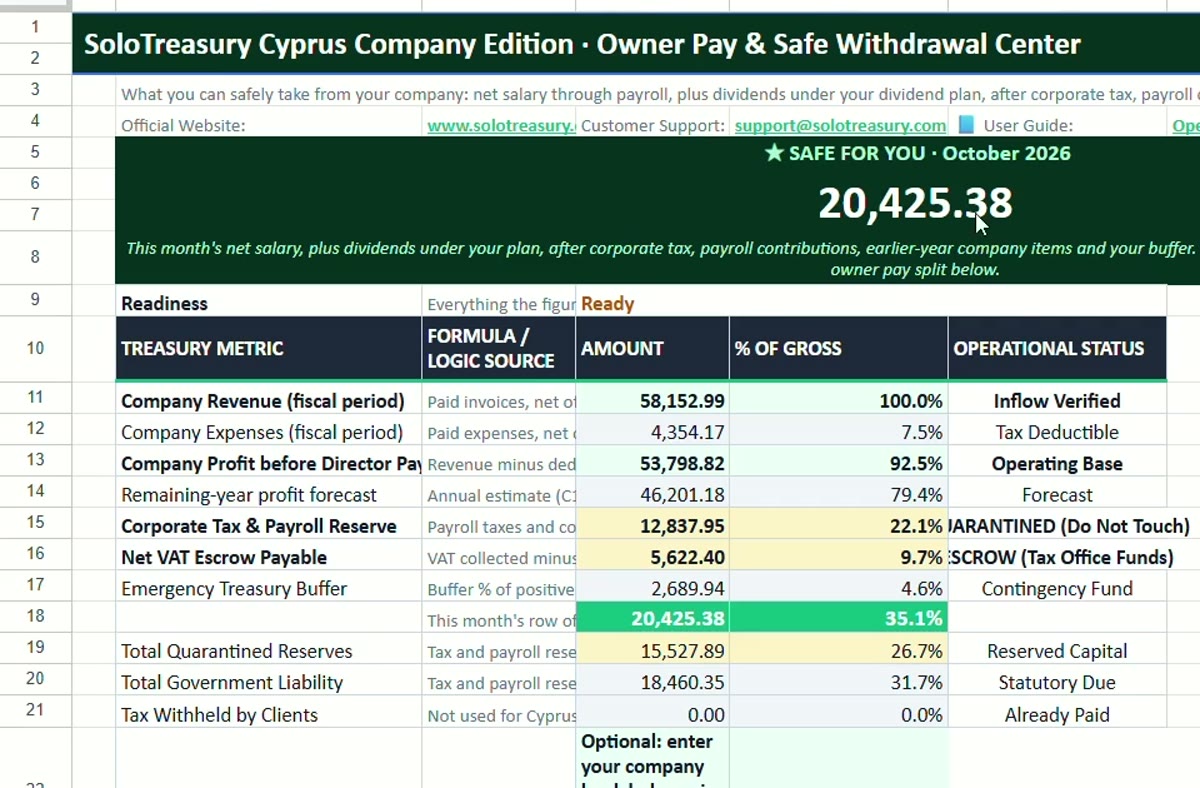 Google Sheet for one Cyprus company · One-time €149
7. Frequently Asked Questions
Can I lend myself money from the company at all?
Nothing in this guide says you cannot. The cost is the 9% deemed benefit a year on the balance, plus the paperwork that records the loan. Ask your accountant how to document it and what the benefit comes to in your case.
Is a company car private use?
Private use of company assets is treated as a disguised dividend, with 10% SDC for a domiciled owner. A company car used privately is an asset in that sense. Your accountant values the private use, so ask how much of your use counts as private.
Does the 9% apply to non-doms?
The deemed benefit falls on the director as an individual. This guide does not distinguish between domiciled and non-domiciled owners for it. Confirm your position with your accountant. The domiciled vs non-dom guide covers what domicile changes for dividends.
Can I repay the loan before year end?
The benefit accrues for the period the balance is outstanding, so an earlier repayment means a shorter period. Confirm the computation with your accountant.
What about expenses I paid privately for the company?
That is the company owing you, which is the opposite direction to a director loan. Keep the receipts and record each payment. The 9% deemed benefit in this guide applies to a balance you owe the company.
9. Sources
Verified October 2026. The figures follow the 2026 Cyprus tax reform and are checked against the rules the SoloTreasury Cyprus Company Edition applies. This guide is planning information and is not tax advice. Confirm every figure with your accountant before you act.