
- Corporate tax: 15% of profit after the payroll cost.
- VAT: what you collected on invoices, less what you paid on expenses.
- Payroll: the director salary plus the employer contributions on it.
- A buffer: an amount you set yourself.
1. Why the monthly question is different from the annual one
The annual question is how much profit the company made and what tax it owes. Your accountant answers it after the year ends.
The monthly question is different. You want to know what you can take out this month. You ask it while the year is still running, so the answer has to come from numbers you can see today.
The bank balance does not answer it. The balance includes money that is already owed. Some of it is VAT collected for the state. Some of it is corporate tax on profit you have already earned. Some of it is next month's payroll.
The accountant's annual figure arrives too late to help. It describes a year that has finished. By then the money has usually been spent.
So the owner needs one number each month, built from the same four reserves every time. This guide shows how to build it.
It is written for the owner-director of one Cyprus tax-resident limited company. It sits next to the owner pay guide, which covers how much you can take out as salary, dividends or both. Every figure here is a planning estimate. Your accountant files the returns and settles the tax, and you should review your routine with them.
2. The four reserves
A monthly reserve has four parts. Each one is money that sits in the company account but is not available to you.
| Reserve | What it covers | How to size it | When the cash leaves |
|---|---|---|---|
| Corporate tax | 15% tax on the company's profit. | 15% of each month's profit after the payroll cost. | Provisional instalments on 31 July and 31 December of the year. The balance on 31 January of year + 2. |
| VAT | VAT you collected on invoices, less VAT you paid on expenses. | At the rates shown on those invoices and receipts. | When the VAT return is paid. |
| Payroll | The director salary plus the employer contributions on it. | The full cost to the company, not just the gross salary. | Each month, through payroll. |
| Buffer | A cushion for a month with lower income or a late customer. | An amount you choose. | It stays in the company until you decide to release it. |
Corporate tax
The company pays 15% tax on its profit after the payroll cost. The salary is a cost, so it comes off the profit first.
The tax is paid in three steps. Two provisional instalments fall due during the year, on 31 July and 31 December. The balance falls due on 31 January of year + 2.
That is the rule for 2026. The 2026 balance is therefore due on 31 January 2028. The balance of the 2025 tax falls due on 1 August 2026 under the old rule.
Reserve the tax every month, even though cash leaves only on a few dates. The instalments and the balance then arrive as payments you have already planned for.
VAT
VAT is not profit. You collect it on behalf of the state.
Reserve the VAT you collected on invoices, less the VAT you paid on expenses. Use the rates printed on those invoices and receipts, because they can differ from one item to the next.
Hold the amount until the VAT return is paid. Never include it in a figure you plan to take. Some invoices, such as those to business customers in other EU countries, are handled differently. The EU VAT reverse charge guide explains how.
Payroll
A director salary costs the company more than the gross amount. The company pays employer contributions on top.
| Employer contribution | Rate |
|---|---|
| Social insurance (SI) | 8.8% |
| GeSY (health) | 2.9% |
| Social Cohesion Fund | 2% |
| Redundancy Fund | 1.2% |
| Industrial Training (HRDA) | 0.5% |
These are estimates of the 2026 employer rates (confirm with your accountant).
A gross salary of €2,500 a month costs the company €2,885. Use that cost in the reserve, not the €2,500.
Your own share of the contributions and your income tax are withheld from your gross pay. They are part of the gross, so they do not add to the company's cost. The salary section of the owner pay guide lists the caps and the income tax bands. Confirm them with your accountant.
The buffer
The buffer is the reserve you set yourself. Its job is to absorb a month with lower income or a customer who pays late.
There is no standard figure. Pick an amount you are comfortable with, write it down and change it when your business changes.
3. A worked half year
A half year shows the routine in numbers. It is a worked case with the same inputs as the hub's example D (the worked example in the hub guide), taken at 30 June. The director draws a gross salary of €2,500 a month and no dividend is planned. The half-year figures are derived, and the arithmetic is shown in the table.
| Line at 30 June | Amount | How it is built |
|---|---|---|
| Profit to date, before the director's pay | €50,000.00 | Income less expenses for the first six months. |
| Payroll cost to date | €17,310.00 | 6 × €2,885. |
| Corporate tax reserve to date | €4,903.50 | 15% of the profit left after the payroll cost. |
| Kept in the company | €27,786.50 | What is left after payroll and the tax reserve. |
| Net salary you have received to date | €12,826.00 | The gross salary less your own contributions and income tax. |
Check line: 17,310 + 4,903.50 + 27,786.50 = 50,000. Every euro of profit is either payroll cost, tax reserve or money kept in the company.
The table leaves out VAT on purpose. VAT is not profit, so it sits in a separate reserve and never enters this calculation.
The €27,786.50 is not free cash. The buffer and any open items from earlier years come out of it first. Only what remains is available to plan as extra pay.
The net salary of €12,826.00 is what has already reached your own account. It is not an extra line in the €50,000 split above, because the company's payroll cost covers it.
The same company over a full year
The same company over a full year, with €100,000 of profit before the director's pay, gives the figures below, as in the worked example in the hub guide.
| Full year | Amount |
|---|---|
| Corporate tax | €9,807.00 |
| After-tax profit kept in the company, no dividend planned | €55,573.00 |
| Your take-home, net salary only | €25,652.00 |
The take-home is the net salary only, because no dividend is paid. The €55,573 stays in the company. It can be paid out later as a declared dividend, and the company then withholds SDC and GeSY.
A reserve works the same way in every month of the year. At the end of the year the monthly amounts add up to the full-year figures above.
4. Earlier-year items that stay reserved across the year end
A new year does not clear an old tax bill. Some items from earlier years stay open, and they must stay in the reserve until they are paid.
- The 2026 corporate tax balance. It is due on 31 January 2028. It stays reserved through all of 2027.
- The transitional deemed dividend charge. It applies to domiciled owners only, on the 2024 and 2025 profits. If it applies to you, hold it back as well. The 2026 reform guide walks through it, and the domiciled vs non-dom guide explains who it affects.
- The 2025 corporate tax balance. Under the old rule it falls due on 1 August 2026. Ask your accountant to confirm it has been paid, and keep it reserved until it is.
Write each open item down with its due date. These items come out of the available figure before you plan any pay.
5. A five-step monthly routine
Run the same five steps at the end of every month. Each step feeds the next.
- Record the month's invoices and expenses with their VAT. Keep the VAT on its own line, so you can see the VAT collected and the VAT paid.
- Compute the month's payroll cost. Use the full cost to the company, which is €2,885 for a gross salary of €2,500.
- Put 15% of the month's profit after payroll aside. This is the corporate tax reserve.
- Add the earlier-year items that are still open. Use the list in section 4.
- Take what is left after the buffer. That is the amount you can plan to take, as salary or as a declared dividend.
Step 5 has two clean routes, and the owner pay guide prices both. Money that leaves the company in any other way, such as a transfer to yourself, can carry its own cost. The director loan guide explains why.
A dividend adds SDC and GeSY, which the company withholds when it pays. Plan them together with the dividend, not inside the monthly reserve. Whether the SDC applies to you depends on whether you are domiciled in Cyprus.
Share your reserve sheet with your accountant before each provisional instalment date. That gives them the chance to compare your estimate with their own computation.
One monthly figure, with the reserves already taken out
SoloTreasury Cyprus Company Edition is a Google Sheet for the owner-director of one Cyprus company. It records your salary and dividend plan, estimates corporate tax, payroll contributions, SDC and GeSY on your share, holds back VAT and a buffer, and shows one monthly figure you can take out. Estimates for you to review with your accountant.
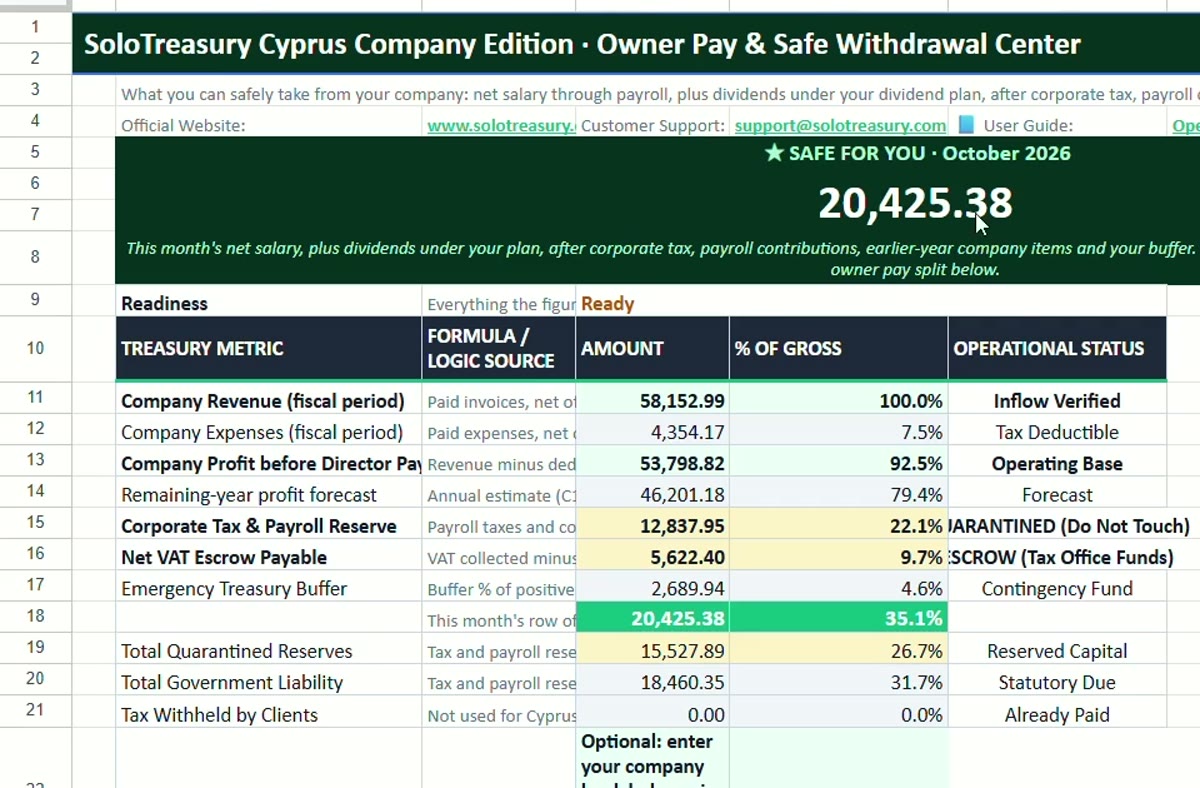 Google Sheet for one Cyprus company · One-time €149
6. Frequently Asked Questions
Do I reserve corporate tax every month or only before the instalments?
Every month. The instalments on 31 July and 31 December are when the cash leaves, not when the tax builds up. If you only look at the balance just before an instalment, the money may already be spent. A monthly reserve of 15% of the profit after payroll means each instalment and the final balance are already set aside.
Is VAT part of my profit?
No. You collect VAT on behalf of the state, and it should never be in the figure you take out. Hold it until the VAT return is paid. For how VAT works on invoices to business customers in other EU countries, see the EU VAT reverse charge guide.
What if the year's profit ends lower than expected?
The reserve is an estimate. If profit ends lower, you have set aside more than you needed, and the extra becomes available. The accountant's provisional tax computation decides the instalments, so share your reserve with them before each instalment date and compare the two.
Does the reserve include the SDC on my dividends?
No. The company withholds SDC and GeSY when it pays a dividend. Plan them together with the dividend, not inside the monthly reserve. The owner pay guide shows the effect on a dividend, and the domiciled vs non-dom guide explains what domicile changes.
How is this different from what my accountant does?
Your accountant files the returns and settles the tax. The reserve is your own monthly planning, so you know what is free to take between filings. Review it with your accountant, who confirms the final figures.
8. Sources
Verified October 2026. The figures follow the 2026 Cyprus tax reform and are checked against the rules the SoloTreasury Cyprus Company Edition applies. This guide is planning information and is not tax advice. Confirm every figure with your accountant before you act.