
- Corporate tax: 15%, up from 12.5%.
- Dividends: SDC of 5% instead of 17% for a domiciled owner, plus GeSY of 2.65%, for profits of 2026 onwards.
- Still to deal with: a transitional deemed dividend on the 2024 and 2025 profits that were not paid out. It applies to domiciled shareholders only. See section 2.
1. What changed on 1 January 2026
The reform changed rates, deadlines and one rule about profit left in the company. The table lists what matters to the owner of a small limited company. Each row sets the old rule against the rule from 1 January 2026.
| Item | Before | From 1 January 2026 |
|---|---|---|
| Corporate tax rate | 12.5% | 15% |
| SDC on dividends to domiciled shareholders | 17% | 5%, for profits of 2026 onwards |
| Deemed dividend distribution | Applied to profit not paid out | Abolished for 2026 profits onwards |
| Tax losses carried forward | 5 years | 7 years |
| Stamp duty | Applied | Abolished |
| Final corporate tax and the TD4 return | Tax on 1 August of year + 1, return on 31 March of year + 2 | Both due 31 January of year + 2 |
| Employment income exemption | Not part of this comparison | New 25% exemption for employment starting 2025 to 2030 |
| Non-dom status | Not part of this comparison | Ends after 17 of the last 20 years of residence |
Four of these rows change what you take home. The higher corporate tax rate takes more off profit before any dividend is paid. The lower SDC rate takes less off the dividend itself. The end of the deemed distribution rule means profit you keep in the company in 2026 is not treated as paid out to you. The tax on 2026 profit is due later, which gives you time but also makes the money easy to spend by mistake.
The 25% employment income exemption is new. It covers employment that starts between 2025 and 2030. Whether your own salary qualifies depends on when your employment began, so ask your accountant.
The non-dom row matters if you are not domiciled in Cyprus. Non-dom status ends after 17 of the last 20 years of residence. The domiciled vs non-dom guide covers what domicile changes for your dividends.
2. The transitional deemed dividend: the one item that still bites
The reform abolishes the deemed dividend distribution for 2026 profits onwards. It does not wipe out the past. A transition applies to the profits of 2024 and 2025. It is the one item in the reform that can still cost you cash.
The transition applies to domiciled shareholders only. A non-domiciled shareholder is outside it. It works like this.
- 70% of the 2024 after-tax profit that is not paid out within two years is treated as distributed on 31 December 2026.
- 70% of the 2025 after-tax profit that is not paid out within two years is treated as distributed on 31 December 2027.
- Nothing is deemed distributed from 2028.
- The charge is 17% SDC plus 2.65% GeSY on the deemed amount, on your share.
- Dividends already paid out of those profits reduce the deemed amount.
The word deemed is the important one. No money reaches you, because the dividend is only treated as paid. The tax on it is still real.
Worked example
A domiciled owner holds 100% of a company. The 2024 after-tax profit was €40,000 and none of it has been paid out. The steps below are plain arithmetic on that example, so the amounts are derived.
| Step | Amount |
|---|---|
| 2024 after-tax profit not paid out | €40,000 |
| Deemed dividend, 70% of that profit (derived) | €28,000 |
| SDC at 17% on €28,000 (derived) | €4,760 |
| GeSY at 2.65% on €28,000 (derived) | €742 |
| Transitional charge, SDC plus GeSY (derived) | €5,502 |
In this example the charge falls due on 31 January 2027. Confirm the date for your own company with your accountant.
Your safe cash to spend is your planned take-home less the €5,502 held back. If you spend the full take-home and forget the charge, you will be short when it falls due. If you own less than 100%, apply your percentage to the deemed amount.
Do not cover the gap with a loan from the company to yourself. A withdrawal of that kind has its own cost. The director loan guide explains it.
3. What changes when: the dates to know
The table puts the reform dates in order. The first two have already passed at the time of writing. Ask your accountant to confirm that both were met.
| Date | What happens | Who it concerns |
|---|---|---|
| 31 July 2026 | First provisional corporate tax instalment for 2026 | Every company |
| 1 August 2026 | Balance of the 2025 corporate tax | Every company |
| 31 December 2026 | Second provisional instalment for 2026, and the deemed distribution date for the 2024 profits | Every company, and domiciled shareholders for the deemed date |
| 31 January 2027 | Transitional charge on the 2024 profits, as in the worked example above | Domiciled shareholders |
| 31 December 2027 | Deemed distribution date for the 2025 profits | Domiciled shareholders |
| 31 January 2028 | Final 2026 corporate tax and the TD4 return | Every company |
Two dates in the table are easy to confuse. 31 December 2026 is the day the 2024 profit is treated as distributed. 31 January 2027 is the day the tax on it falls due, in the worked example. Keep both in your calendar, and ask your accountant to confirm the second one for your company.
The monthly reserve guide shows how to hold money back for each of these dates.
4. Salary or dividends after the reform
The 15% corporate tax comes off profit before any dividend is paid. A dividend to a domiciled owner now carries 5% SDC and 2.65% GeSY, where before it carried 17% SDC and 2.65% GeSY. The estimator in the hub guide splits a profit figure between salary and dividends using the 2026 rules.
5. Before 31 December 2026: a checklist
Five steps will put you in a position to decide. Work through them with your accountant.
- Ask for the profit still in the company. You need the 2024 and 2025 after-tax profit that has not been paid out, and the dividends already paid from it.
- Decide whether to pay out or keep. Profit paid out as a dividend within the two years is not left in the pool for the deemed dividend. The choice is yours to make with your accountant.
- Set the transitional charge aside. Hold the amount back so that your spendable cash is take-home less the charge. The monthly reserve guide shows how.
- Confirm your domicile. The charge applies to domiciled shareholders only. The domiciled vs non-dom guide sets out the difference.
- Record the provisional instalment dates. Write down 31 July and 31 December for corporate tax, and 31 January 2028 for the final 2026 tax and the TD4 return.
Keep the answers in one place. A record of the figures your accountant gave you is what you will need again next year.
See your planned salary and dividends next to the taxes the company owes
SoloTreasury Cyprus Company Edition is a Google Sheet for the owner-director of one Cyprus company. It records your salary and dividend plan, estimates corporate tax, payroll contributions, SDC and GeSY on your share, holds back VAT and a buffer, and shows one monthly figure you can take out. Estimates for you to review with your accountant.
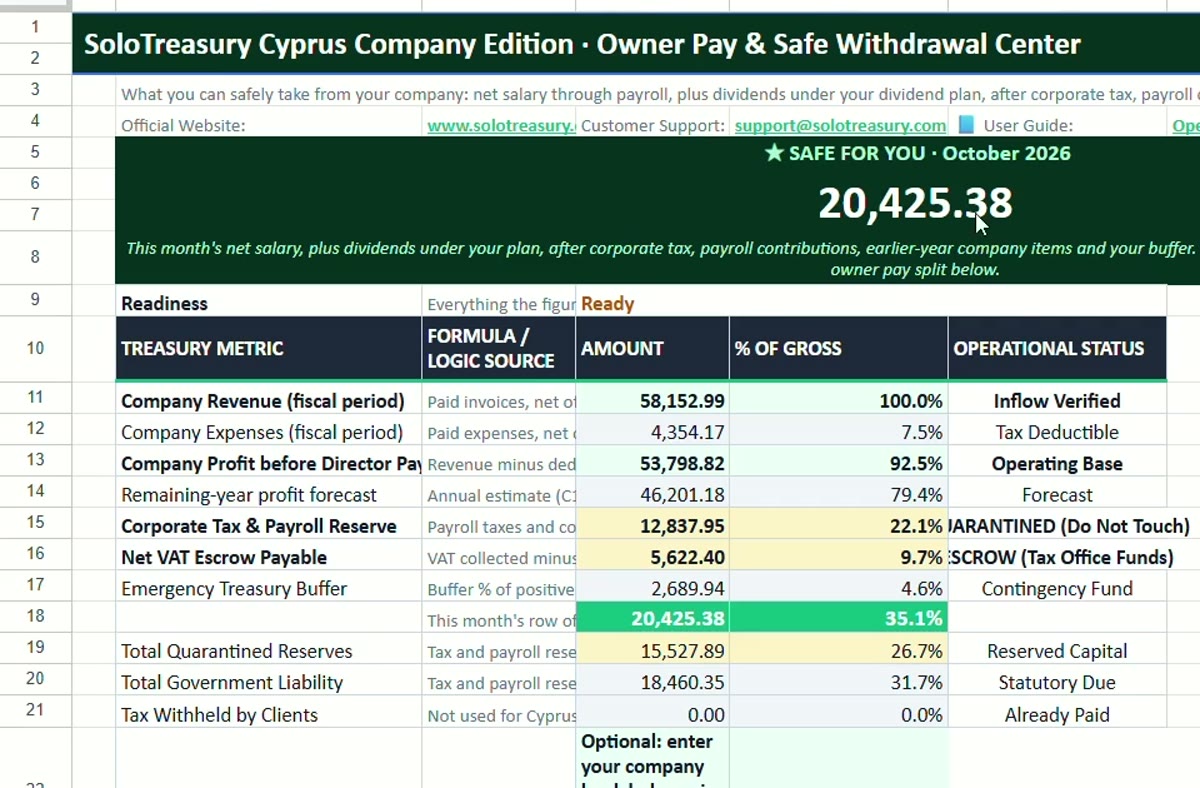 Google Sheet for one Cyprus company · One-time €149
6. Frequently Asked Questions
Is the 17% SDC gone?
Only for profits of 2026 onwards. A dividend paid out of 2026 profits to a domiciled shareholder carries 5% SDC plus GeSY of 2.65%. A dividend paid out of profits earned before 2026 still carries 17% SDC if it is paid up to 31 December 2031. The transitional deemed dividend in section 2 also carries 17%. Ask your accountant which year of profit each dividend comes from.
Does the transitional deemed dividend apply to non-doms?
No. The transitional deemed dividend applies to domiciled shareholders only. A non-domiciled owner is outside it. The domiciled vs non-dom guide explains what domicile changes and when non-dom status ends. Ask your accountant to confirm your status.
I am the only shareholder. Does the transitional charge apply to me?
Yes, if you are domiciled in Cyprus. The charge is calculated on your share of the deemed amount. With 100% of the shares, your share is the whole amount. Dividends you have already taken out of the 2024 or 2025 profits reduce it. Your accountant can give you the figure for your own company.
Is the 15% charged on all profit?
It is charged on taxable profit, which is the profit after the payroll cost and the usual tax adjustments. Your accountant works out the adjustments. A tax loss can now be carried forward for 7 years instead of 5. The hub guide shows how the payroll cost reduces the profit that is taxed.
When is the 2026 corporate tax finally due?
There are two provisional instalments, on 31 July 2026 and 31 December 2026. The final corporate tax and the TD4 return for 2026 are due on 31 January 2028. That is 31 January of year + 2. Before the reform the dates were 1 August of year + 1 and 31 March of year + 2. See the dates in section 3.
8. Sources
Verified October 2026. The figures follow the 2026 Cyprus tax reform and are checked against the rules the SoloTreasury Cyprus Company Edition applies. This guide is planning information and is not tax advice. Confirm every figure with your accountant before you act.