
- SDC: 5% for a domiciled owner on 2026 profits, 0% for a non-domiciled owner.
- GeSY: 2.65% for both (confirm with your accountant). Non-doms pay it too.
- Transitional deemed dividend: domiciled owners only.
1. The two statuses
Two statuses matter for dividends. Each one is a short definition.
Non-dom. A non-dom is a Cyprus tax resident without a Cyprus domicile of origin. Most owners who moved to Cyprus as adults start here. A domicile of origin is a legal link to a country that you get at birth, so it does not change because you moved.
Deemed domiciled. Non-dom status does not last for ever. You become deemed domiciled once you have been Cyprus tax resident for 17 of the last 20 years. From that point the dividend rules treat you as domiciled.
A paid extension exists. It costs €250,000 per five-year period. It is outside this guide, so ask your accountant if it could matter to you.
In this guide, "domiciled" means a person with a Cyprus domicile of origin or a deemed domicile. "Non-domiciled" and "non-dom" mean the opposite.
2. Side by side
The table below sets the two statuses next to each other for a dividend paid by your company in 2026. The rates are the same ones the hub guide uses.
| Item | Domiciled | Non-domiciled |
|---|---|---|
| Income tax on dividends | Exempt | Exempt |
| SDC on dividends from 2026 profits | 5% | 0% |
| SDC on pre-2026 profits paid out up to 31 December 2031 | 17% | 0% |
| GeSY on dividends (confirm with your accountant) | 2.65% | 2.65% |
| Transitional deemed dividend | Applies | Does not apply |
| Who withholds and pays | The company, by the end of the month after the dividend | The company, by the end of the month after the dividend |
Three points are worth reading twice.
- Both statuses are exempt from income tax on dividends. The difference sits in SDC and GeSY.
- GeSY does not depend on status. A non-dom pays the same 2.65% as a domiciled owner.
- The 17% rate is for older profit. It applies to profit from before 2026 that is paid out up to 31 December 2031. Ask your accountant which profits a dividend comes from.
The transitional deemed dividend is a one-off charge on earlier years that were not paid out. It applies to domiciled owners only. The 2026 reform guide goes through it.
Salary is not in the table because status does not change it. Payroll tax and contributions are the same for both statuses.
3. The same company, two owners
The clearest way to see the difference is to give two owners the same company. The company has €100,000 of profit before the owner's pay. The owner draws a €2,500 monthly salary. The company pays out all of its after-tax profit as dividends. The starting case is the domiciled owner, the same company as case A in the worked example in the hub guide.
| Domiciled owner (hub example A) | Non-dom owner (derived) | |
|---|---|---|
| Dividends | €55,573.00 | €55,573.00 |
| SDC on dividends | €2,778.65 | €0.00 |
| GeSY on dividends | €1,472.68 | €1,472.68 |
| Take-home per year | €76,973.67 | €79,752.32 |
Where the figures come from. The domiciled column is case A in the worked example in the hub guide. The non-dom column is derived from it by removing SDC.
How the derived figure works. The non-dom owner is a worked case with the same inputs as the hub's example and no employment exemption. SDC is €0 instead of €2,778.65, and every other line is equal. The take-home is therefore the domiciled take-home plus the SDC saved: €76,973.67 plus €2,778.65 is €79,752.32.
The gap of €2,778.65 a year is the whole effect of status in this case. It comes from SDC alone.
Both owners still pay GeSY of €1,472.68. Status does not touch it.
This is an estimate for one set of inputs. Your salary, your shareholding and your exemptions will move the figures, so confirm your own case with your accountant. The hub guide has the full worked examples and an estimator.
4. The 17-year clock
If you are non-dom today, your status has an end date. The clock is the 17-of-20-years rule.
How the count works
- It counts years of residence. The question is how many of the last 20 years you were Cyprus tax resident.
- It does not count the age of the company. A young company does not reset your clock, and an old company does not speed it up.
- The 20 years are counted again each year, so the status can change; your accountant confirms where you stand. Each year you look back at the latest 20 years, so the window moves forward.
- You become deemed domiciled at 17. From then, the domiciled column in section 2 applies to you.
What to do in the year before it turns
Plan in the year before the count reaches 17, not after.
- Count with your accountant. Write down which years you were resident, and ask your accountant to confirm the total.
- Expect SDC of 5% on later dividends. Once you are domiciled, dividends from 2026 profits carry SDC of 5%. Profit that stays in the company does not carry it until it is paid out.
- Ask which date the status test uses. Ask whether the status on the day a dividend is paid is the one that counts.
- Check the transitional rule. It applies to domiciled owners and covers earlier years of profit. By the time you turn domiciled it may already be behind you, so ask your accountant whether it can still reach you.
- Ask about the paid extension. The extension is outside this guide, but your accountant can say whether it is worth pricing.
None of this is a recommendation to pay or to delay a dividend. It is a list of questions that keeps the conversation with your accountant short.
5. Confirming your status
Your status is your own statement. Nobody certifies it for you, and the company relies on what you tell it.
Your accountant confirms it. They check your residence years, your domicile of origin and any extension you hold. Their answer is the one to work from.
The SoloTreasury sheet works the same way. You enter your status, and the sheet shows Review until you confirm it. The word Review is a prompt to check with your accountant. It is not a certification and it does not decide your status.
Three habits keep this simple.
- Keep a dated note of the years you were Cyprus tax resident.
- Tell the company if your status changes, because it withholds SDC on that basis.
- Review the status once a year, in the same month as your other year-end checks.
Record your status and see the dividend tax it produces
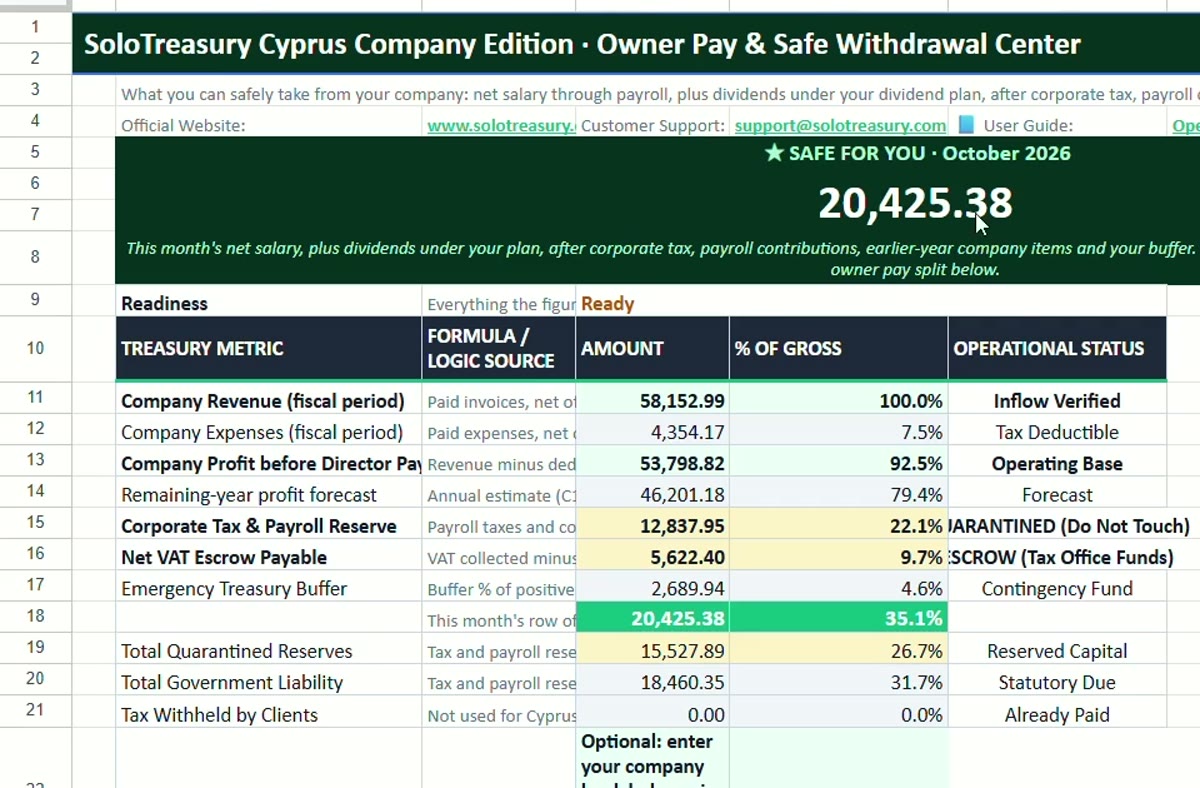
SoloTreasury Cyprus Company Edition is a Google Sheet for the owner-director of one Cyprus company. You record whether you are domiciled or non-domiciled, and the sheet estimates SDC and GeSY on your share of each dividend. It shows Review until you confirm your status with your accountant. Estimates for you to review with your accountant.
 Google Sheet for one Cyprus company · One-time €149
6. Frequently Asked Questions
Do non-doms pay anything on Cyprus dividends?
Yes, GeSY. A non-domiciled owner pays 0% SDC on dividends, but GeSY of 2.65% still applies. GeSY is charged on income up to €180,000 in total, salary and dividends together (confirm with your accountant). Dividends are exempt from income tax for both statuses. The side-by-side table shows each charge.
Does non-dom status affect salary?
No. Salary tax and social contributions are the same for a domiciled and a non-domiciled owner. Status changes the tax on dividends, not the tax on payroll. The hub guide covers the salary side.
Does the transitional deemed dividend apply to me as a non-dom?
No. The transitional deemed dividend applies to domiciled owners only. A non-domiciled owner is outside it. Ask your accountant to confirm your status before you rely on that. The 2026 reform guide explains the charge.
What if I became Cyprus tax resident in 2010?
Count the 17-of-20-years rule with your accountant. This guide does not decide it for you. The count is years of Cyprus tax residence in the last 20 years, so the answer depends on which years you were resident. Section 4 explains how the count works.
Does the company care about my status?
Yes. The company withholds the dividend taxes, so it needs to know whether to withhold SDC. A domiciled owner has 5% SDC withheld on 2026 profits, and a non-domiciled owner has none. GeSY of 2.65% is withheld in both cases (confirm with your accountant). The company pays both over by the end of the month after the dividend is paid.
8. Sources
Verified October 2026. The figures follow the 2026 Cyprus tax reform and are checked against the rules the SoloTreasury Cyprus Company Edition applies. The non-dom take-home of €79,752.32 is derived from case A in the worked example in the hub guide by removing SDC. This guide is planning information and is not tax advice. Confirm every figure with your accountant before you act.