
- Salary: deductible for the company, with contributions and income tax on your side.
- Dividends: exempt from income tax, with SDC of 5% on profits from 2026 onwards (0% if non-domiciled) and GeSY of 2.65% up to the ceiling, both withheld by the company.
- Both: a salary and a dividend can be combined, and the estimator shows the result.
1. The short answer: three routes and what each costs in 2026
You can pay yourself from a Cyprus company in three ways. You can draw a salary, you can take dividends, or you can do both. Each route is taxed differently.
| Route | What the company pays | What you pay | When the money arrives |
|---|---|---|---|
| Salary | The salary is a cost, so it comes off profit before the 15% corporate tax. The company also pays employer contributions of about 15.4% on top of gross. At €2,500 a month that is €385, so the total cost is €2,885. | Employee social insurance (SI) of 8.8%, GeSY of 2.65% and income tax through payroll (PAYE) on what is left. | Every month, through payroll. |
| Dividends | Corporate tax of 15% on profit first. Dividends are paid only from profit that is left after that tax. | Special defence contribution (SDC) of 5% on profits from 2026 onwards if you are domiciled in Cyprus, or 0% if you are non-domiciled. GeSY of 2.65% in both cases, up to the ceiling. Dividends are exempt from income tax. | When the company declares and pays the dividend. |
| Both | The salary cost and its employer contributions, then 15% corporate tax on the profit after that. | The salary deductions above, plus SDC and GeSY on each dividend. | Salary monthly, dividends when declared. |
The GeSY rates on salary and the employer fund contributions are for your accountant to confirm. The full table is in section 3.
Two terms are worth knowing. SDC is the special defence contribution, a tax on dividends. GeSY is the national health contribution. Both are withheld by the company.
The estimator below puts numbers on all three routes. Section 5 shows three worked examples.
2. Owner-pay estimator: salary, dividends, or both (2026 rules)
Enter your numbers. The estimate updates as you type. Nothing leaves your browser.
Estimates under the 2026 rules for a full year. Eligibility for an exemption, your domicile and the social insurance treatment of a shareholder-director are for your accountant to confirm. The transitional charge on 2024 and 2025 profits is not included; see section 7.
Need this each month, not just for one estimate?
The estimator helps you compare salary and dividends. SoloTreasury Cyprus Company Edition is the Google Sheet for keeping that plan up to date as you record invoices and expenses. See your planned owner pay alongside the amounts held back for company tax, payroll, VAT and a buffer.
€149 one-time · Google account required · One-time Google authorization to use the sheet. Planning estimates to review with your accountant, not tax advice or filing software.3. Salary through payroll
A salary is paid through payroll. The company withholds your share of the contributions and the income tax, and pays its own share on top.
Contributions in 2026
| Contribution | Employee | Employer | Cap |
|---|---|---|---|
| Social insurance (SI) | 8.8% | 8.8% | Maximum insurable earnings of €5,742 per month in 2026, applied month by month |
| GeSY (health) | 2.65% | 2.9% | €180,000 total income (confirm with your accountant) |
| Social Cohesion Fund | - | 2% | No cap (confirm with your accountant) |
| Redundancy Fund | - | 1.2% | The SI cap (confirm with your accountant) |
| Industrial Training (HRDA) | - | 0.5% | The SI cap (confirm with your accountant) |
Check the GeSY rates and the three fund rates with your accountant too. With these rates, at a salary of €2,500 a month the employer contributions are about 15.4% of gross, which is €385. The total cost to the company is €2,885 a month.
Personal income tax bands in 2026
Confirm the bands with your accountant before you rely on a figure.
| Taxable income | Rate |
|---|---|
| Up to €22,000 | 0% |
| €22,001 to €32,000 | 20% |
| €32,001 to €42,000 | 25% |
| €42,001 to €72,000 | 30% |
| Above €72,000 | 35% |
The tax is progressive. Each rate applies only to the part of your income inside that band.
Your employee SI and GeSY are deductible, up to one fifth of your income after any exemption. The estimator uses this cautious reading, which gives the lower take-home figure. Confirm it with your accountant.
The three employment income exemptions
Some owners qualify for an exemption on part of their salary. The estimator applies the amount you choose and assumes you qualify.
| Exemption | Amount | Main conditions |
|---|---|---|
| 20% | 20% of salary, up to €8,550 a year, for 7 years | Conditions on prior residence and earlier employment apply. Confirm with your accountant. |
| 25% | 25% of salary, up to €25,000 a year, for 7 years | Employment started between 2025 and 2030, and salary over €30,000 in the first 12 months. Other conditions apply. |
| 50% | 50% of salary, for 17 years | Salary above €55,000, and not Cyprus resident for the 15 consecutive years before. |
Only one exemption applies, and only once. Whether you are eligible is for your accountant to confirm.
4. Dividends
A dividend is paid from profit the company has already been taxed on. The order matters.
- The payroll cost of any salary comes off the profit first.
- The company pays 15% corporate tax on what is left.
- The after-tax profit can then be distributed.
- Your share of it depends on your shareholding. At 60%, you receive 60% of the amount paid out.
- The company withholds SDC (5% on profits from 2026 onwards if you are domiciled, 0% if you are not) and GeSY of 2.65% up to the ceiling, and pays them over by the end of the month after the dividend is paid.
Dividends are exempt from income tax. Non-domiciled owners still pay GeSY. The domiciled vs non-dom guide explains what domicile changes.
The 5% SDC applies to profits from 2026 onwards. A rate of 17% still applies to profits from before 2026 that are paid out up to 31 December 2031. Ask your accountant which profits a dividend comes from.
5. Three worked examples
All three use a company with €100,000 of profit before your pay, a salary of €2,500 a month (€30,000 a year) and a 100% shareholding. They are estimates for a full year under the 2026 rules.
| A: domiciled | B: non-domiciled, 20% exemption | D: domiciled, no dividend | |
|---|---|---|---|
| Your status | Domiciled | Non-domiciled | Domiciled |
| Employment exemption | None | 20% | None |
| Dividend plan | Pay out all after-tax profit | Pay out all after-tax profit | Keep profit in the company |
| Payroll cost to the company (salary plus employer contributions) | €34,620.00 | €34,620.00 | €34,620.00 |
| Employer contributions | €4,620.00 | €4,620.00 | €4,620.00 |
| Corporate tax at 15% | €9,807.00 | €9,807.00 | €9,807.00 |
| Dividends | €55,573.00 | €55,573.00 | €0.00 |
| Personal income tax on salary | €913.00 | €0.00 | €913.00 |
| SDC on dividends | €2,778.65 | €0.00 | €0.00 |
| GeSY on dividends | €1,472.68 | €1,472.68 | €0.00 |
| Your take-home per year | €76,973.67 | €80,665.32 | €25,652.00 |
A to B: example B is non-domiciled and uses the 20% exemption. That removes the SDC and the income tax on the salary, so the take-home rises from €76,973.67 to €80,665.32.
A to D: in example D no dividend is paid. The after-tax profit stays in the company, so the take-home is only the net salary of €25,652.00. The money is not lost. It is still in the company and can be paid out later.
Run your own numbers in the estimator, and confirm the result with your accountant.
6. Loans and private use: what they cost
Taking money out of the company without payroll or a declared dividend has a cost.
- A loan from the company to you, or an overdrawn balance on your account, is a deemed benefit of 9% a year.
- Private use of company assets, or buying a company asset from it below market value, is a disguised dividend with 10% SDC (domiciled).
Take money as payroll salary or as a declared dividend. The director loan guide covers both rules in more detail.
7. Earlier years: the transitional deemed dividend
Before 2026, a company could be treated as having distributed profit it had not paid out. That rule is abolished for 2026 profits onwards. A transition applies to earlier years, for domiciled owners only.
- 70% of the 2024 after-tax profit that has not been paid out is treated as distributed on 31 December 2026.
- 70% of the 2025 after-tax profit that has not been paid out is treated as distributed on 31 December 2027.
- The deemed dividend carries 17% SDC and 2.65% GeSY.
The estimator does not include this charge. The 2026 reform guide for owner-directors goes through it. Check your own position with your accountant.
8. Keeping a monthly reserve
The money in the company account is not all yours. Hold some back each month for what the company will owe.
- Corporate tax: provisional instalments on 31 July and 31 December, then the balance on 31 January of year + 2. The 2026 balance is due on 31 January 2028.
- VAT collected from customers and not yet paid over.
- Payroll cost: the salary and the employer contributions on it.
- A buffer for the months when income is lower.
The monthly reserve guide shows what to hold back and when.
Need this each month, not just for one estimate?
The estimator in section 2 helps you compare salary and dividends. SoloTreasury Cyprus Company Edition is the Google Sheet for keeping that plan up to date as you record invoices and expenses. See your planned owner pay alongside the amounts held back for company tax, payroll, VAT and a buffer.
€149 one-time · Google account required · One-time Google authorization to use the sheet. Planning estimates to review with your accountant, not tax advice or filing software.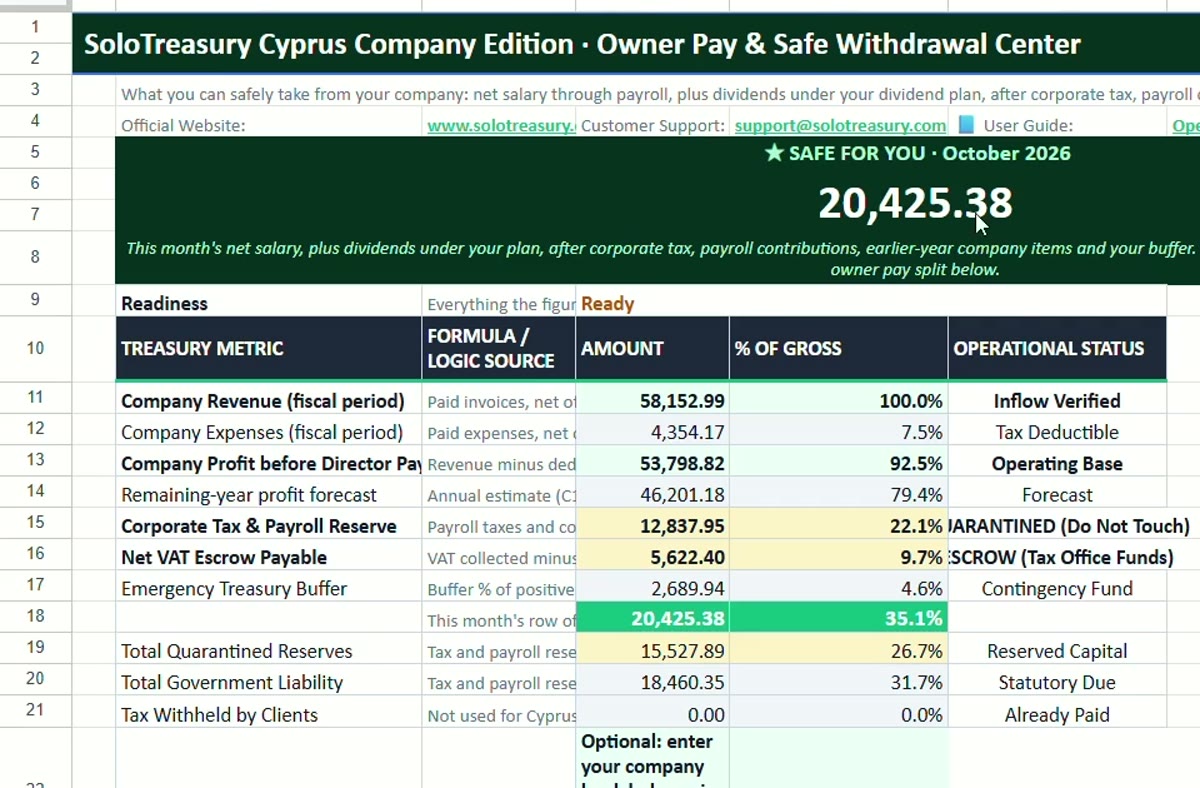 Google Sheet for one Cyprus company · One-time €149
9. Frequently Asked Questions
Is salary or dividends cheaper for a Cyprus company owner in 2026?
It depends on your exemption and your domicile. On €100,000 of profit with a €2,500 monthly salary, the estimated take-home is €76,973.67 for a domiciled owner who pays out all after-tax profit (example A), €80,665.32 for a non-domiciled owner using the 20% exemption (example B), and €25,652.00 if no dividend is paid and the profit stays in the company (example D). Dividends avoid social insurance but carry GeSY of 2.65% up to the ceiling and, if you are domiciled, SDC of 5% on profits from 2026 onwards. Salary carries contributions and income tax, but it comes off profit before the 15% corporate tax. Confirm your own case with your accountant. See the three worked examples in section 5.
Do non-doms pay anything on dividends?
Yes, GeSY. A non-domiciled owner pays 0% SDC on dividends, but GeSY of 2.65% (up to the ceiling) still applies to both domiciled and non-domiciled owners. Dividends are exempt from income tax for both. The domiciled vs non-dom guide goes into what domicile changes.
Does a 100% shareholder-director pay social insurance like an employee?
The SoloTreasury Cyprus Company Edition treats a 100% shareholder-director as an employee, at 8.8% for the employee and 8.8% for the employer. One reading says controlling shareholders are self-employed instead. Ask your accountant which treatment applies to you.
When does the company pay the SDC and GeSY on my dividends?
The company withholds both when it pays the dividend. It pays them over by the end of the month after the dividend is paid.
What happens if I just transfer money to myself without payroll or a dividend?
A loan or an overdrawn balance owed by you to the company is treated as a deemed benefit of 9% a year. Take money out as payroll salary or as a declared dividend instead. Section 6 explains the rule. The director loan guide goes into it.
When do I lose non-dom status?
After you have been Cyprus tax resident for 17 of the last 20 years. A paid extension exists, but this guide does not cover it. Ask your accountant to confirm your status. The domiciled vs non-dom guide covers the 17-of-20-years rule.
11. Sources
Verified October 2026. The figures follow the 2026 Cyprus tax reform and are checked against the rules the SoloTreasury Cyprus Company Edition applies. This guide is planning information and is not tax advice. Confirm every figure with your accountant before you act.